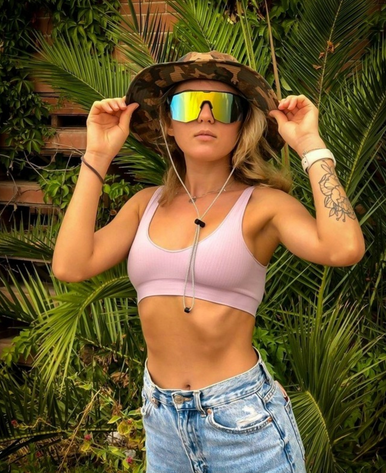
Best Cheap Baseball Sunglasses: What to Look For Under $50
Baseball eats sunglasses. They get sat on in dugouts, dropped chasing foul balls, left on bleachers, and stuffed into bat bags next to cleats. That's exactly why paying $180 for a big-brand pair makes no sense for most players — and why "cheap" doesn't have to mean junk. Here's what actually matters in a pair of baseball sunglasses under $50, and what you can skip.
The non-negotiables
UV400 protection
You're outside for two to three hours a game, usually mid-day. UV400 (blocking 99–100% of UVA/UVB) is the whole reason sunglasses exist. Every Flight lens is UV400 — it's the floor, not a feature.
Impact-resistant lenses
A baseball off the lip of a glove, a bad hop in the infield — you want polycarbonate-style impact resistance between that and your eye, not glass or bargain-bin acrylic. This matters more than any brand name on the arm.
Real coverage
A sport wrap frame that covers your full field of view, including the top edge — because fly balls come out of the sky, and squinting over a small lens to track one is how you lose it in the sun. Our Accelerator is the shape you're looking for: semi-rimless sport wrap, big top coverage, light enough to forget it's on.
A fit that survives a sprint
If your glasses shift when you break for second, they're gone by August. Look for rubber TPR nose pads and grippy arms — sweat makes smooth plastic slick, and July doubleheaders are a sweat test.
Lens color: what helps you track a ball
- Mirror lenses (gold, silver) knock down harsh glare on bright, cloudless days — the classic outfielder pick.
- Smoke/gray keeps colors true and works everywhere, infield or out.
- Transition lenses are the sleeper pick for players who go from afternoon games to evening practices — they darken in sun and clear up as light fades, so one pair covers a full day at the field. See our transition lens lineup.
What you can skip at this price
Polarization is nice on water; on a ballfield it's optional — some players even find it changes how they read the ball off the bat. Don't pay a premium for it. Skip fancy case bundles, interchangeable-lens systems you'll never swap, and anything marketed on the logo instead of the lens.
The honest math
A $28–42 pair with UV400, impact-resistant lenses, and a sport fit does the same job on the field as the $180 pair — and when it eventually gets stepped on in the dugout, it's an annoyance instead of a tragedy. Ours are backed by a warranty, and right now we run Buy 2, Get 1 Free with free U.S. shipping over $50 — one for the field, one for the truck, and a backup for the bat bag.
Recent Posts
-

Polarized vs. Non-Polarized Sunglasses for Golf: Which Do You Actually Need?
Here's the short answer: for golf, it depends on what's actually costing you strokes — glare or gree …Jul 30th 2026 -
Polarized vs. Non-Polarized Sunglasses for Fishing: Which Do You Actually Need?
Here's the short answer: if you fish, polarized lenses are the one sunglasses upgrade that's actuall …Jul 23rd 2026 -
Best Cheap Baseball Sunglasses: What to Look For Under $50
Baseball eats sunglasses. They get sat on in dugouts, dropped chasing foul balls, left on bleachers, …Jul 22nd 2026